O Gauge Railway Track
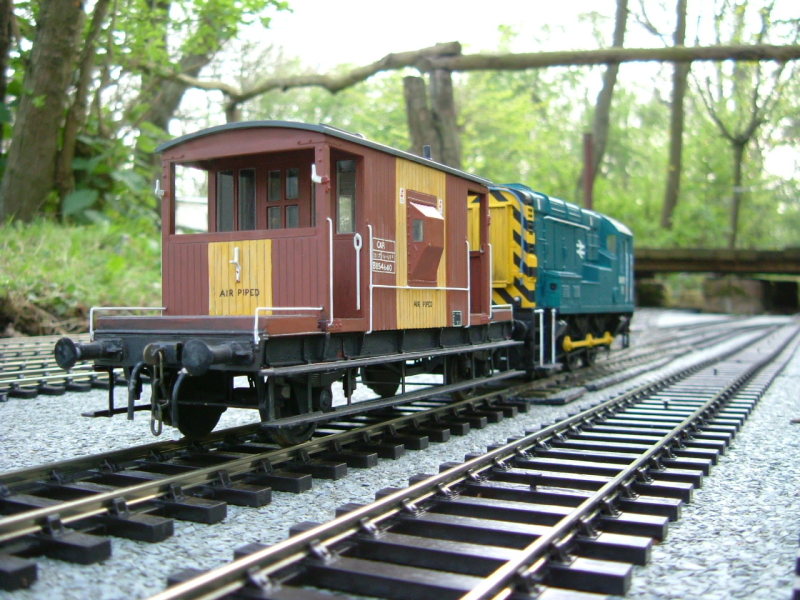
The club's O Gauge lines were constructed in the 1960's. At this time the club's stock was tinplate and locos were powered by clockwork. For this reason the stations were placed close enough together to allow a clockwork train to run from one station to the next.
The route was laid out as double track with passing loops at most stations except the junction stations where the tracks diverged at the facing end of the station. At this time track was constructed from wooden battens and "Bonds" track components. These consisted of cast white metal chairs supporting brass rail. All the track was hand built. This must have been a time consuming, but rewarding, experience.
The battens were made up of 3/8" approx square wooden strip. Since most of the route is double track it made sense to make the battens wide enough support two tracks. The wood was creosoted before assembly to extend its life. The rails were pinned down to the battens using the cast whitemetal chairs and small panel pins. Pointwork was constructed in a similar fashion, except that some soldering was needed.
The battens were fixed to a concrete base which in turn sat on a brick wall. The battens were screwed to pieces of wood that had been embedded in the concrete base. The trackwork was very much coarse scale to suit the tinplate stock used at the time.
Unfortunately during the 1970's the track suffered periodic vandalism when the site was broken into. Often there was insufficient time to make repairs before the next open day, when it was necessary to have the layout operating.
In order to get things running again, the decision was taken to use PECO Flexitrack instead of the Bond's track components. As before, battens were used to support the PECO track. The replacement of the Bond's track occurred as a gradual process through the late 1970's and 1980's. The last section to be replaced was the section between Minford and Stockton (its location in a cutting may have meant it was harder to vandalise). PECO and Marcway points were also used.
The use of PECO track had an effect on the type of stock used. Some of the tinplate stock used had wheel flanges which were too deep to run on the PECO track.
The current method of track laying uses 18mm thick recycled plastic planks screwed to a concrete base. The planks then have a layer of roofing felt added to the surface mainly to improve the appearance. Track is then easily pinned down on top. For station areas, large sheets of recycled plastic are cut to the required size which are also covered in roofing felt.
In some areas the original brick walls which supported this base have deteriorated due to frost damage and ground-heave. These walls have been replaced with new walls constructed from concrete blocks.
The pointwork uses a mixture of PECO, Marcway and scratch built pointwork. Most points are fitted with an over-centre spring to hold them locked in place. Recently we have developed a point which accommodates both fine and coarse scale wheels. Our intention to convert all points to this type over the next few years. Pointwork construction is simplified due to the fact that the rails are not electrified and therefore the point frogs and tie-bars do not have to be insulated.